
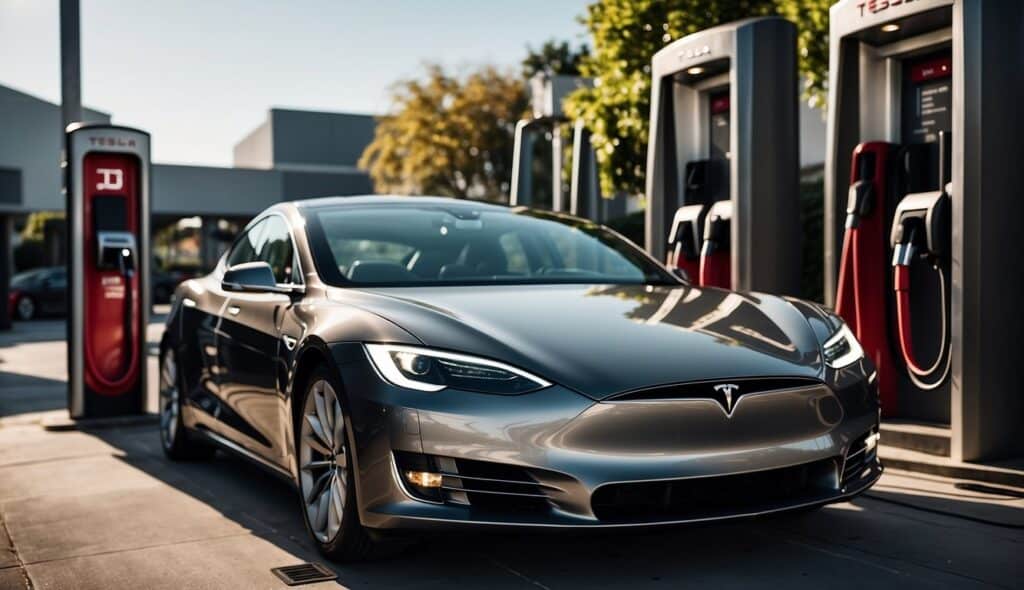
Charging a Tesla using a Supercharger is an efficient way to get back on the road quickly.
A Tesla Supercharger can charge a Tesla to 80% in about 30 minutes. For a full charge, it takes just over an hour.
This makes it convenient for long road trips where quick stops can keep you going.
Superchargers are designed for fast charging, ideal for drivers who need to top up their battery quickly. This system ensures that Teslas spend less time charging and more time driving.
Using a Supercharger also helps avoid long waits, reducing idle time significantly.
Superchargers are strategically located to support long-distance travel and are easy to find through the Tesla app.
They are available in most urban areas and along major highways, offering Tesla drivers both convenience and speed.
Understanding Tesla’s Supercharger Network
Tesla’s Supercharger network allows for quick and efficient charging. The network spans many regions and continues to grow, featuring two main types of chargers: V3 and V4.

Development and Coverage
The Supercharger network was launched in 2012. It has grown significantly, covering over 30 countries.
Superchargers are placed strategically near highways, restaurants, and shopping centers.
Tesla’s aim is to reduce range anxiety for drivers. Superchargers are designed to make long-distance travel possible.
In the U.S. alone, there are thousands of Supercharger stations. Europe and Asia also have extensive networks.
The goal is to have a Supercharger within reach for most drivers. Expansion continues, with plans for new installations.
Superchargers Types: V3 and V4
The V3 Superchargers were introduced in 2019. They offer charging speeds up to 250 kW. This can add up to 15 miles per minute to a vehicle’s range.
V3 Superchargers are suitable for long trips, cutting down charge times significantly.
V4 Superchargers are the latest in development. They are expected to offer even faster charging speeds.
Details are still emerging, but they will improve efficiency and performance.
Both types use direct current (DC) fast-charging technology. This allows for rapid energy delivery directly to the battery.
Charging times are faster than home or public Level 2 chargers.
Check out Tesla Charger Blinking Green When Not Plugged In
Basics of Tesla Battery and Charging Technology
Tesla vehicles are powered by advanced batteries and efficient charging systems. Understanding these elements is important for optimizing charging and vehicle performance.
Battery Capacity and Size
Tesla batteries vary in capacity and size, impacting range and charging time.
Common battery sizes include 50 kWh, 75 kWh, and 100 kWh. Larger batteries offer longer range but take more time to charge.
For example, a Tesla Model 3 with a 75 kWh battery can cover more miles than one with a 50 kWh battery.
Tesla uses lithium-ion batteries, known for their energy density and durability. These batteries ensure that Tesla vehicles maintain consistent performance and efficiency over time.
Onboard Charger and Charging Methods
The onboard charger in Tesla vehicles converts AC power from charging stations into DC power stored in the battery.
The power rating of the onboard charger affects how fast the battery charges. A higher wattage onboard charger means quicker charging times.
Tesla offers several charging methods:
- Standard Wall Outlet (Level 1): Slowest method, using a 120V outlet. Charging can take up to 40 hours.
- Tesla Wall Connector (Level 2): Uses a 240V outlet, reducing charge time to around 11-12 hours.
- Tesla Supercharger: Uses DC fast charging. Can charge to 80% in about 30 minutes, providing a quick boost for long trips.
These methods cater to different needs, from daily home charging to quick stops at Supercharger stations.
Read Tesla Charger Green Light but Not Charging
Charging Your Tesla with a Supercharger
Charging your Tesla with a Supercharger involves quickly replenishing the battery using DC fast charging technology. This section explains how to initiate a charging session and highlights the efficiency of Tesla Superchargers.
Initiating a Charging Session
To start a charging session, open the Tesla app on your smartphone and locate the nearest Supercharger station.
Tap on the menu in the top-right corner and navigate to the ‘Charging’ section.
Once arrived at the Supercharger station, park the vehicle at a vacant charging spot and connect the Supercharger cable to the Tesla’s charging port.
No additional authentication or payment steps are needed since the cost is automatically linked to your Tesla account.
Monitoring the charging status in real-time is possible through the Tesla app, which provides updates on the charging rate and estimated completion time.
Ensuring the designated Supercharging payment method in the app helps streamline the process.
Tesla Supercharger (DC Fast Charging)
Tesla Superchargers use DC fast charging, significantly reducing the time required to recharge the vehicle.
On average, a Tesla can charge to 80% in about 30 minutes using a Supercharger, making it convenient for road trips and long-distance travel.
These chargers are capable of delivering up to 250 kW of power, allowing for efficient battery replenishment.
Charging from 0 to 100% can typically take around an hour or slightly more, depending on the vehicle model and battery capacity.
Tesla’s network of Superchargers is strategically placed along popular routes and in urban areas, ensuring drivers have access to fast charging stations when needed.
The integration of these stations with Tesla’s navigation system helps in planning routes and identifying charging stops along the way.
Check out Tesla Wall Charger Green and Blue Light Issues
How Long Does Charging Take?
Charging times for a Tesla can vary depending on the model and other factors. Superchargers provide a fast way to charge, but different conditions can influence the exact time needed.
Factors Influencing Charging Time
The total time it takes to charge a Tesla can depend on multiple factors.
One key factor is the charging power of the Supercharger, measured in kilowatts (kw). The higher the kw, the quicker the car charges. For example, Tesla Superchargers can deliver up to 250 kw.
Another important factor is the car’s state of charge. Charging from a very low battery level to a higher state generally takes longer. Efficiency also decreases as the battery nears 100%.
Weather conditions can play a role, as extreme temperatures can slow down the charging process.
Tesla’s battery management system adjusts the charging speed to protect the battery from damage.
Time Estimates for Different Models
Each Tesla model has slightly different charging times at a Supercharger.
For instance, the Model 3 can get up to 80% charge in around 25-30 minutes.
The Model S typically takes about the same time to reach 80% but may take longer to hit a full charge.
For the Model X, an 80% charge can take roughly 30 minutes as well, but a full charge might require more time due to its larger battery.
The Model Y shares similar charging times with the Model 3, often taking about 30 minutes to reach 80%.
Read Tesla Says Ready To Charge But Not Charging
Supercharger Accessibility and Amenities
Tesla’s Supercharger network ensures that drivers can easily access charging stations located on major travel routes. These stations are often situated near convenient facilities and restaurants, making long trips more comfortable and convenient.
Locations and Travel Routes
Superchargers are strategically placed along key travel routes to maximize accessibility.
Tesla owns and operates over 50,000 Superchargers worldwide, placed near highways and major roads to ensure seamless travel.
These stations are accessible 24/7, making it possible to charge your Tesla any time of day or night.
Drivers can find the nearest Supercharger using the Tesla app or the vehicle’s touchscreen.
The app shows real-time availability of chargers and can plan routes that incorporate necessary charging stops.
This planning feature is especially useful for long-distance travel, reducing the stress of finding an available charging station.
Nearby Facilities and Restaurants
Many Supercharger stations are located near a variety of amenities to enhance the charging experience.
These often include restaurants, hotels, and shopping centers.
While waiting for their vehicle to charge, drivers can grab a meal, shop, or relax at nearby locations.
For example, a Supercharger might be near a popular fast-food chain or a coffee shop, allowing drivers to enjoy a quick bite or a cup of coffee.
Some stations are even close to larger retail complexes, offering more options for dining and entertainment.
This setup not only provides convenience but also makes the charging wait time more enjoyable.
Check out How Many Miles Can a Tesla Go on One Charge?
Comparing Charging Options
Different charging options for a Tesla offer varied benefits depending on one’s needs and circumstances. Key factors include charging speed, convenience, and cost.

Home Charging Versus Supercharging
Home Charging can be done using a Tesla’s Wall Connector or a standard outlet.
A Wall Connector typically requires installation but charges much faster than a regular outlet, providing up to 44 miles of range per hour.
A standard outlet, also known as Level 1 charging, is much slower, providing about 3-4 miles of range per hour.
Supercharging, on the other hand, is ideal for long trips or when quick charging is necessary.
Superchargers can provide up to 200 miles of range in about 15 minutes.
They are located strategically to support long-distance travel and are easy to find using Tesla’s built-in navigation.
Pros of Home Charging:
- Convenience: Charge at home, overnight.
- Cost: Generally cheaper than Supercharging.
Cons of Home Charging:
- Speed: Significantly slower than Supercharging, even with a Wall Connector.
- Installation: Wall Connector requires professional installation, which can be costly.
Pros of Supercharging:
- Speed: Very fast, ideal for road trips or emergencies.
- Availability: Extensive network, easy to find and use.
Cons of Supercharging:
- Cost: More expensive than home charging per kilowatt-hour.
- Battery Health: Frequent use can accelerate battery degradation over time.
Level 2 AC Charging and Public Chargers
Level 2 AC Chargers can be installed at home or found in public spaces. These chargers use a 240V outlet and offer a good balance between speed and cost.
At home, they require a Tesla Wall Connector, providing up to 44 miles of range per hour. It usually takes around 8-12 hours to fully charge a Tesla.
Public Chargers are often Level 2 chargers but can vary in speed and cost. They are suitable for locations where one stays for a considerable period, like shopping centers or workplaces.
Charging speeds can range between 15-25 miles of range per hour, depending on the charger and vehicle model.
Pros of Level 2 Charging:
- Speed: Faster than Level 1 and suitable for daily use.
- Availability: Increasing number of public chargers.
Cons of Level 2 Charging:
- Cost: Installation at home can be expensive.
- Accessibility: Public chargers can be occupied or require wait times.
Public Chargers:
- Benefits: Convenient for those without home charging. Increasing availability in urban areas.
- Drawbacks: Can be costly per session and might be busy during peak times.
Read How to Commission Your Tesla Wall Charger?
Cost of Charging at a Supercharger Station
The cost of charging a Tesla at a Supercharger station varies based on location and time of use. Users can estimate costs by understanding the pricing structure and using calculators.
Pricing Structure
Tesla’s Supercharger stations typically charge users based on the amount of electricity consumed, measured in kilowatt-hours (kWh). Rates can vary widely, often depending on local electricity prices and demand.
For example, in some areas, charging rates might be around $0.25 per kWh. However, this can increase to $0.50 per kWh or more in other regions.
Tesla also includes idle fees, which are charged when a car remains plugged in after charging is complete. If the station is over 50% full, these fees apply until the vehicle is moved.
Estimating Charging Costs
To estimate how much it will cost to charge a Tesla at a Supercharger, owners can use tools like the Tesla app or various online calculators.
For instance, the Supercharger Cost Calculator helps users compare costs between home charging and Supercharging.
Using the app, owners can track their charging history and expenses. The app also allows users to enter their vehicle’s battery level and local electricity rates to get a better estimate.
Generally, charging from 0% to 100% might cost between $15 and $30, but this can be higher or lower based on local rates and the specific model of the Tesla.
Preparing for a Supercharger Visit
Before heading to a Supercharger, make sure your Tesla is properly set up for a quick and efficient charging experience. This includes having a preconditioned battery to optimize charging time.
Preconditioned Battery for Optimal Charging
It is crucial to precondition the battery for the fastest charging experience. Preconditioning warms up the battery to its ideal temperature for charging.
This step is important because a colder battery charges slower and less efficiently.
Owners can use the Tesla app to start preconditioning before reaching the Supercharger. The app’s navigation feature also helps by automatically preconditioning the battery when navigating to a Supercharger.
This ensures that the vehicle is ready for optimal charging upon arrival. Regular use of the app can lead to better management of battery temperature and more efficient charging habits.
Preconditioning is typically done shortly before arriving at a Supercharger, making it a simple but effective step in preparing for a charge.
Electric Vehicle Charging Standards and Plug Types
Electric vehicle (EV) charging comes in several standards, each with different speeds and connectors. Understanding these variations helps EV owners choose the best charging options for their needs.
AC and DC Charging Explained
Alternating Current (AC) charging is commonly used at home and public stations. It involves two levels:
- Level 1 Charging: Uses a standard 120V outlet, offering 3 to 5 miles of range per hour. It’s the slowest method, ideal for overnight charging.
- Level 2 Charging: Uses a 240-volt outlet, similar to what electric dryers use. This method adds about 25-30 miles of range per hour, making it suitable for home use with equipment like Tesla’s Wall Connector and public stations.
Direct Current (DC) Fast Charging delivers power directly to the battery, bypassing the onboard charger. This method is much faster, offering significant charge in minutes rather than hours. DC fast chargers are found in places where quick charging is essential, such as along highways for long-distance travel.
Tesla’s Unique Connector and Adaptability
Tesla uses a proprietary connector in North America, different from the standard J1772 plug used by other EVs. This exclusive connector works with Tesla’s Supercharger network and Wall Connector for home use.
Tesla provides adapters to ensure compatibility with other charging networks. For example, Tesla owners can use a CHAdeMO adapter for certain DC fast chargers.
These adapters make it easier for Tesla drivers to access a broader range of charging stations.
In Europe, Tesla vehicles come with a CCS Combo connector, used widely across many EV brands. This ensures that Tesla owners in Europe can utilize a variety of public chargers without needing additional adapters.
Maintaining Battery Health Over Time
To maintain battery health over the long term, EV owners should follow best practices and understand the impact of different charging methods, including supercharging, on battery life.
Best Practices
To maximize battery life, avoid depleting the battery frequently. Instead, keep the charge between 20% and 80%.
This reduces stress on the battery cells and helps maintain their capacity.
Regular charging at home using a 240V Level 2 charger is ideal. It provides a stable charging routine that is gentle on the battery.
Charging to 100% should be reserved for long trips. For daily use, keeping the charge below 90% helps reduce wear.
For those who commute daily, it is best to charge the vehicle at home each night. This routine ensures the battery remains within an optimal state of charge.
Avoid letting the battery sit at a low or high charge for extended periods.
Impact of Supercharging on Battery Life
Using a Tesla Supercharger can significantly speed up charging times, but frequent use can affect long-term battery health.
Supercharging uses high current levels, which generate more heat. Over time, this can lead to faster battery degradation compared to slower charging methods.
For occasional use, Supercharging should not significantly damage the battery. However, relying on Superchargers regularly can reduce the battery’s overall lifespan.
If possible, limit Supercharging to when it is absolutely necessary, such as during long trips or emergencies.
For most of their charging needs, EV owners should use home chargers or public Level 2 chargers.
Conclusion
Charging a Tesla with a Supercharger is efficient and relatively quick.
On average, a Tesla Supercharger takes about 60 minutes to charge a Tesla from 0 to 100%.
Charging up to 80% takes around 30 minutes for those seeking a shorter stop. This is useful for most daily driving needs.
Different factors affect charging times, including battery size, Supercharger version, and current battery level.
Summary of Charging Times
| Charging Method | Time to Full Charge | Time to 80% Charge |
|---|---|---|
| Tesla Supercharger V3 | ~60 minutes | ~30 minutes |
| Tesla Supercharger V2 | ~66 minutes | ~36 minutes |
These estimates provide a clear idea of what to expect when using a Tesla Supercharger.
You may also like:
- How Many kWh to Charge a Tesla?
- How To Afford a Tesla Electric Car
- How Much Does It Cost to Replace an Electric Car Battery in UK?
Hi, I’m Marybeth, an electric car enthusiast living in New York in the USA. As the owner of electriccartalks.com, I love sharing my knowledge on EV tips, battery maintenance, and charging solutions. As a proud Tesla owner, I blend my personal experiences with professional insights to offer valuable information to fellow EV enthusiasts. Through my articles, I aim to empower others to make informed decisions about their electric vehicles. Read more