
As electric vehicles (EVs) become more popular, understanding the costs associated with charging them is crucial for potential buyers and current owners. One common question is, “How much does it cost to charge an electric car for 300 miles?” This guide will break down the factors influencing charging costs, compare them to traditional gasoline vehicles, and provide tips on how to minimize expenses.
To charge an electric car for 300 miles typically costs between $10 to $14, depending on the vehicle’s efficiency and local electricity rates. For example, a Tesla Model 3, with an efficiency of about 4 miles per kWh, would cost approximately $12 at the average U.S. residential electricity rate of $0.16 per kWh. This makes EV charging significantly cheaper compared to fueling a gasoline vehicle.
Understanding Electric Vehicle Charging
Types of Charging Stations
There are three main types of EV charging stations:
- Level 1 Charging: This is the most basic form of charging, using a standard 120-volt household outlet. It is the slowest method, providing about 2-5 miles of range per hour.
- Level 2 Charging: These chargers use a 240-volt outlet, similar to what is used for large home appliances. They can provide 10-60 miles of range per hour, making them suitable for home and public charging stations.
- DC Fast Charging: These are the fastest chargers available, capable of providing up to 80% charge in 20-40 minutes. They are typically found at public charging stations and are ideal for long-distance travel.
Factors Affecting Charging Costs
Several factors influence the cost of charging an EV, including:
- Electricity Rates: The cost per kilowatt-hour (kWh) varies by location and time of day.
- Vehicle Efficiency: Different EV models have varying levels of energy efficiency, typically measured in miles per kWh.
- Charging Speed: Faster charging methods can sometimes be more expensive due to higher demand charges.
- Location: Public charging stations may have different pricing structures compared to home charging.
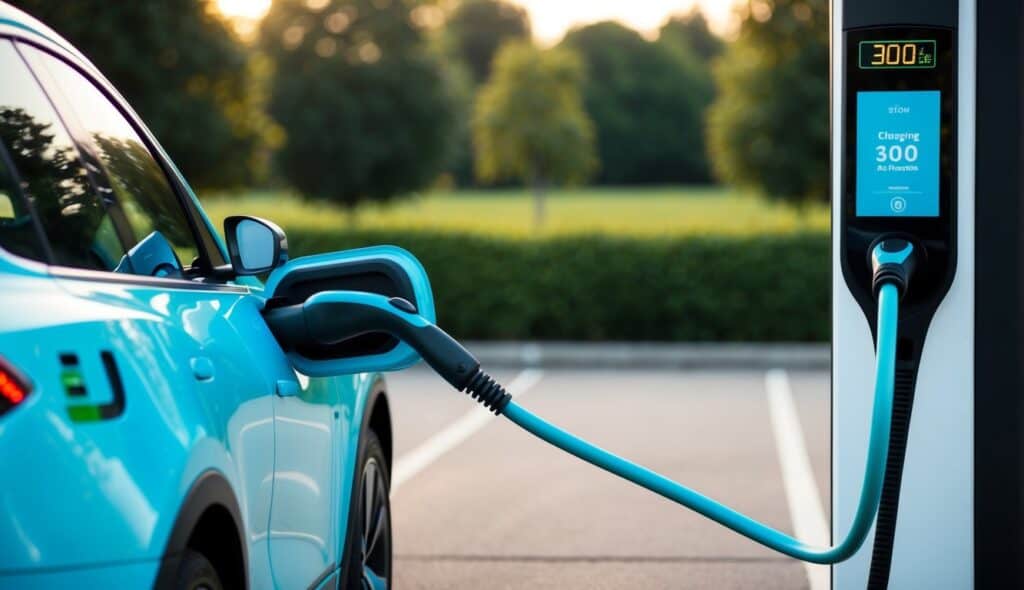
Calculate the Cost to Charge an EV for 300 Miles
Average Electricity Rates
The average residential electricity rate in the United States is approximately $0.16 per kWh. However, this rate can vary significantly by state. For example, electricity rates in California are higher than the national average, while rates in states like Louisiana are lower.
Vehicle Efficiency
The efficiency of an EV is typically measured in miles per kWh. For instance, a Tesla Model 3 has an efficiency of about 4 miles per kWh, while a Ford Mustang Mach-E averages around 3.5 miles per kWh.
Example Calculation
Let’s calculate the cost to charge a Tesla Model 3 for 300 miles:
- Determine the total kWh needed: 300 miles ÷ 4 miles per kWh = 75 kWh
- Calculate the cost: 75 kWh × $0.16 per kWh = $12.00
Therefore, it would cost approximately $12.00 to charge a Tesla Model 3 for 300 miles at the average U.S. residential electricity rate.
Check out Does an Electric Car Lose Charge When Parked?
Comparing Charging Costs Across Different EV Models
When comparing charging costs across different electric vehicle (EV) models, several factors come into play, including each vehicle’s energy efficiency, battery capacity, and the cost of electricity.
Energy efficiency, measured in miles per kilowatt-hour (miles/kWh), varies between models and directly impacts the overall charging cost. Here are some examples to illustrate these differences:
- Tesla Model 3:
- Efficiency: Approximately 4 miles per kWh
- Cost to Charge for 300 Miles: 300 miles ÷ 4 miles per kWh = 75 kWh
- Total Cost: 75 kWh × $0.16 per kWh = $12.00
- Ford Mustang Mach-E:
- Efficiency: Around 3.5 miles per kWh
- Cost to Charge for 300 Miles: 300 miles ÷ 3.5 miles per kWh = 85.7 kWh
- Total Cost: 85.7 kWh × $0.16 per kWh = $13.71
- Nissan Leaf:
- Efficiency: About 3.9 miles per kWh
- Cost to Charge for 300 Miles: 300 miles ÷ 3.9 miles per kWh = 76.9 kWh
- Total Cost: 76.9 kWh × $0.16 per kWh = $12.31
- Chevrolet Bolt EV:
- Efficiency: Approximately 3.8 miles per kWh
- Cost to Charge for 300 Miles: 300 miles ÷ 3.8 miles per kWh = 78.9 kWh
- Total Cost: 78.9 kWh × $0.16 per kWh = $12.63
These examples highlight how the efficiency of each EV model influences the overall cost of charging. While the differences may seem minor, they can add up over time, especially for frequent drivers.
Other factors, such as the availability of home charging, access to public charging stations, and potential membership discounts, can further impact the total cost of owning and operating an EV.
Check out Do Hotels Charge for Electric Car Charging?
Factors That Can Influence Charging Costs
Time of Day
Some utility companies offer time-of-use (TOU) rates, which vary based on the time of day. Charging during off-peak hours (typically late at night) can be significantly cheaper than during peak hours.
Public Charging Stations
Public charging stations often have different pricing structures. Some may charge by the minute, while others charge by the kWh. Additionally, fast chargers tend to be more expensive than Level 2 chargers.
Subscription Plans
Some charging networks offer subscription plans that can lower the cost per kWh. For example, EVgo and Electrify America have membership plans that provide discounted rates for frequent users.
Home Charging vs. Public Charging
Charging at home is generally cheaper than using public charging stations. Home charging allows you to use lower residential electricity rates and TOU pricing. However, the convenience of public charging stations, especially fast chargers, can be worth the extra cost for long trips.
Check out How to Charge Electric Cars in Hot Weather?
Comparing EV Charging Costs to Gasoline Vehicles
Fuel Efficiency of Gasoline Vehicles
To compare the costs, let’s consider a gasoline vehicle with an average fuel efficiency of 25 miles per gallon (mpg). If the average cost of gasoline is $3.50 per gallon, the cost to drive 300 miles would be:
300 miles ÷ 25 mpg = 12 gallons
12 gallons × $3.50 per gallon = $42.00
Cost Comparison
- Tesla Model 3: $12.00 to charge for 300 miles
- Gasoline Vehicle: $42.00 to drive 300 miles
As seen, charging an EV can be significantly cheaper than fueling a gasoline vehicle.
Tips to Minimize EV Charging Costs
Install a Home Charger
Installing a Level 2 charger at home can be a cost-effective solution for regular charging. It allows you to take advantage of lower residential electricity rates and TOU pricing.
Use Public Charging Wisely
When using public chargers, try to use Level 2 chargers for regular charging and reserve fast chargers for long trips. Additionally, consider subscribing to charging networks that offer discounted rates.
Monitor Electricity Rates
Keep an eye on your local electricity rates and consider switching to a TOU plan if available. Charging during off-peak hours can result in significant savings.
Optimize Vehicle Efficiency
Driving habits can impact your EV’s efficiency. Smooth acceleration, maintaining a steady speed, and minimizing the use of air conditioning and heating can help maximize your vehicle’s range and reduce charging costs.
Check out Can Any Electric Vehicle Use a Tesla Charging Station?
Future Trends in EV Charging
Advancements in Charging Technology
As technology advances, charging speeds are expected to increase, making EVs even more convenient for long trips. Additionally, the cost of charging infrastructure is likely to decrease, making it more accessible to a broader audience.
Renewable Energy Integration
Integrating renewable energy sources, such as solar and wind power, into the grid can further reduce the environmental impact and cost of charging EVs. Homeowners with solar panels can potentially charge their EVs at little to no cost.
Government Incentives
Many governments offer incentives for EV owners, such as tax credits and rebates for installing home chargers. These incentives can help offset the initial costs and make EV ownership more affordable.
Conclusion
Charging an electric car for 300 miles can cost anywhere from $10 to $23, depending on various factors such as electricity rates, vehicle efficiency, and charging location. Unlike gasoline vehicles, EVs offer significant cost savings and environmental benefits. By understanding the factors influencing charging costs and implementing cost-saving strategies, EV owners can maximize their savings and enjoy the benefits of electric driving.
You may also like:
- How Long To Charge Electric Car On 110v?
- How Much Does It Cost to Charge an Electric Car?
- How Long Do Electric Car Batteries Last?

Hi, I’m Marybeth, an electric car enthusiast living in New York in the USA. As the owner of electriccartalks.com, I love sharing my knowledge on EV tips, battery maintenance, and charging solutions. As a proud Tesla owner, I blend my personal experiences with professional insights to offer valuable information to fellow EV enthusiasts. Through my articles, I aim to empower others to make informed decisions about their electric vehicles. Read more