
Electric vehicles are becoming increasingly popular, but many wonder how well they perform in cold weather.
For those looking for the best electric car for winter, options like the Audi E-Tron Quattro SUV and Hyundai Kona stand out for their robust range and reliable performance.
These models handle lower temperatures effectively, offering features such as all-wheel drive and heated seats.
Cold weather can impact EV range, making it crucial to choose models that preserve their driving range even in freezing temperatures.
The Hyundai Kona is known for staying close to its stated range, making it a dependable choice for winter drives.
Meanwhile, the Audi E-Tron Quattro SUV offers a range of 222 miles and fast charging capabilities, making it a strong contender for winter readiness.
Selecting the right electric vehicle can ensure seamless driving experiences even in the coldest months.
By considering factors like range and driveability, drivers can find the perfect EV to meet their needs in winter conditions.
For further details, you can check out these recommendations on the best EVs for winter driving.
Fundamentals of Electric Vehicles in Cold Weather
Cold weather affects the performance and efficiency of electric vehicles (EVs) in significant ways. Understanding these impacts and how EVs compare to traditional gasoline cars during winter conditions is essential for making informed decisions.
Impact of Cold Weather on EV Performance
Cold temperatures can reduce an EV’s driving range and charging speed.
For example, at 32 degrees Fahrenheit, an EV battery can lose about 36% of its usable energy compared to warmer temperatures. This means that drivers may need to charge their vehicles more frequently.
EVs often use a portion of their battery power to heat the cabin, further reducing the overall range.
Batteries operate less efficiently in cold weather since the chemical reactions within the battery are slower.
Heat pumps can be used to warm the battery and cabin, which helps maintain range but may still not fully counteract the loss.
Planning ahead and preconditioning the EV by heating it while it’s still plugged in can help reduce the impact of cold weather on the vehicle’s range.
Comparison with Gasoline Cars in Winter Conditions
In winter conditions, gasoline cars also face challenges but in different ways.
They may experience starting issues in extremely cold weather, but once the engine is running, gasoline engines generate heat that can be used to warm the cabin without impacting fuel efficiency significantly.
Unlike EVs, gasoline cars do not see a drastic reduction in range due to the cold.
However, EVs benefit from not needing oil changes or dealing with other cold weather-related engine issues that gasoline cars face.
Additionally, EVs often come equipped with features like heated seats and steering wheels, which use less energy than heating the whole cabin, making them more efficient in cold weather driving.
Understanding these differences helps drivers prepare for winter driving and choose the best vehicle for their needs.
Check out 10 Best Electric Cars for Road Trips
Technical Aspects of EVs in the Cold
Electric vehicles (EVs) face specific challenges in cold weather, such as reduced battery efficiency and increased energy consumption for heating. Understanding these technical aspects is key to maximizing performance in the winter months.
Battery Technology and Cold Weather
In cold temperatures, the performance of EV batteries decreases. Ideal temperatures for battery operation are around 70°F.
When temperatures drop, batteries don’t charge as effectively. For instance, at 32°F, a standard EV battery can have up to 36% less usable energy compared to 77°F. This means the car’s range is reduced, making it important for drivers to plan their trips and charging stops more carefully during the winter.
Heating Systems: Heat Pump vs. Resistance Heating
Heating an EV in cold weather can consume a significant amount of energy.
There are generally two types of heating systems used in EVs: heat pumps and resistance heating.
Heat pumps are more efficient as they transfer heat rather than generating it, thus using less battery power.
Resistance heating generates heat by passing electricity through a resistor, consuming more energy and thereby reducing the driving range.
Many modern EVs now use heat pumps to improve efficiency in winter conditions.
Energy Consumption and Range Losses
Cold weather impacts EV energy consumption in several ways.
Besides the drain from heating systems, cold weather increases the energy required to maintain battery temperature and can also stiffen lubricants, increasing drivetrain resistance.
For example, it is common to see a range reduction of around 16% in freezing temperatures.
The Hyundai Kona was one of the best performers in a winter test, showing only a 9.91% drop from its stated range, demonstrating that vehicle choice can impact cold weather efficiency.
Check out How Much Does It Cost to Maintain an Electric Car Per Year?
Best Electric Cars for Cold Climates
Electric vehicles are increasingly popular in cold climates. Factors like range, performance, and special features are essential.
Tesla Models: Innovations for Cold Weather
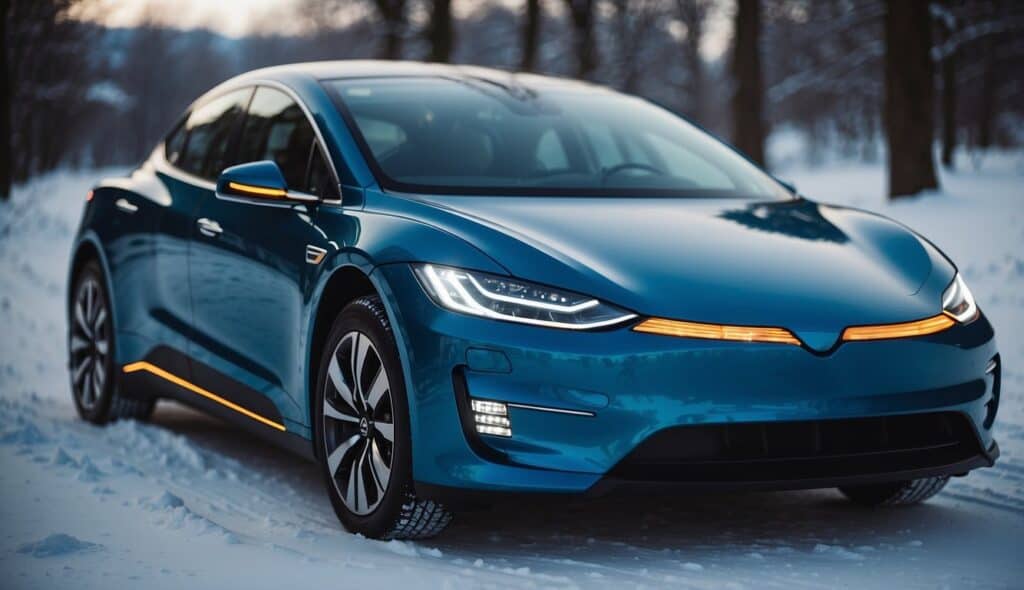
Tesla offers several models that perform well in winter.
The Tesla Model Y and Tesla Model 3 include features like all-wheel drive and heated seats.
The Model S is also known for its long-range capability, making it a great option for cold weather driving.
Tesla’s advanced battery management system helps preserve range in freezing temperatures. Their vehicles even have a feature that preconditions the battery to optimal temperature before driving.
Korean EVs: Hyundai and Kia Highlights
Among Korean EVs, the Hyundai Ioniq 5 stands out for its winter performance. It offers good range and fast charging even in cold weather.
The Hyundai Kona is another solid option, known for maintaining its efficiency in low temperatures.
Kia’s EV6 is also noteworthy. It shares many of the same features as its Hyundai counterparts, including battery preconditioning. Users can expect reliable range and comfort with heated seats and steering wheels.
American Contributions: Polestar and Ford
The Polestar 2 is a strong contender from an American-Swedish collaboration. It offers all-wheel drive and a heating system that includes a heat pump suited for cold weather.
Ford’s Mustang Mach-E and F-150 Lightning both bring excellent capability to winter driving.
The Mach-E provides a combination of range and performance, while the F-150 Lightning adds robust utility, making it an excellent choice for those needing a pickup in snowy conditions. Both models benefit from heated interiors and advanced battery management systems.
Check out Can You Drive an Electric Car Through Water?
Cold Weather Features in EVs
Electric vehicles (EVs) need specific features to handle the challenges of winter driving. This includes maintaining driving range, providing warmth and comfort, and ensuring safety on icy roads.
Essential Features for Winter Driving
All-wheel drive (AWD) is crucial for maintaining traction on snowy and icy roads. AWD helps distribute power equally to all wheels, improving stability and control.
Regenerative braking is another important feature. It helps recharge the battery when braking, which can be particularly useful when driving in stop-and-go traffic during winter.
Advanced climate control systems allow drivers to pre-condition the car, warming it up before getting in.
This not only makes the ride more comfortable but also reduces the energy required to heat the car while driving.
Innovative Comfort Features
Heated seats and a heated steering wheel are key comfort features in cold weather. They provide direct warmth to the driver and passengers, reducing the need to use the car’s main heating system.
Some EVs come with remote start or pre-conditioning through a mobile app.
This allows the driver to heat the cabin and seats before even stepping outside, ensuring a cozy environment from the moment they get in.
Additionally, features like heated mirrors can be very practical. They prevent fog and ice buildup, improving visibility and safety during winter drives.
Driving Range and Efficiency in Cold Conditions
Cold weather can impact an EV’s range and efficiency.
For example, the Hyundai Kona preserves a significant portion of its range, even in cold conditions.
Using features like climate control and heated seats can lower the impact on the battery, helping maintain a better range.
Another strategy is using a heat pump system, which heats the cabin more efficiently than traditional resistive heaters.
This system reduces the energy drain on the battery, allowing the EV to maintain a higher range in winter conditions.
Check out How Much CO2 Does an Electric Car Produce Per Year?
Driving and Maintenance Tips
Proper handling and maintenance of an electric vehicle (EV) can greatly enhance its performance and longevity in cold weather. Here are some specific ways to ensure optimal driving experience and battery health.
Preconditioning Your EV for Optimal Performance
Preconditioning your EV is crucial in cold weather to maintain battery efficiency.
Battery preconditioning involves warming up the battery before you start driving.
Many EVs have a feature that allows you to set a departure time, which helps precondition the battery while the car is plugged in.
Using a home charger is recommended. This keeps your car plugged in overnight, ensuring that the battery is at an ideal temperature when you start driving. This reduces initial range loss and improves overall performance.
Keeping the car in a garage also helps.
A garage can protect your EV from extreme cold, maintaining a more stable battery temperature.
Using seat warmers instead of the cabin heater is another efficient way to keep warm and conserve battery power.
Maximizing Range and Battery Health
Maximizing your EV’s range in cold weather involves several strategies.
Properly inflated tires are essential.
Cold weather causes air in tires to contract, which can lead to decreased tire pressure and higher rolling resistance. Regularly check and refill tires to maintain optimal pressure levels.
Slower driving speeds can extend range.
Driving at lower speeds reduces the energy demand on the battery, helping it last longer.
Planning charging stops is important for long trips.
Knowing where you can charge along your route ensures you are never caught off-guard by a low battery.
Avoiding full charges and deep discharges can protect battery health.
Keeping the battery level between 20% and 80% can reduce wear and prolong the battery’s lifespan.
Check out Why Are Electric Cars Depreciating So Much?
Charging Solutions During Winter
Charging an electric vehicle (EV) in cold weather requires extra care and planning. Conditions like lower temperatures can affect EV range and charging speed. Below, specific strategies are outlined for different charging scenarios during winter.

Home Charging in Cold Temperatures
When charging at home in cold weather, it’s best to use a covered space like a garage. This helps maintain a stable temperature for the battery.
Plugging in the car overnight can keep the battery warm, preventing it from losing charge.
Using the preconditioning feature is also important. This warms up the battery before you start driving.
Always try to keep the battery above 20% to avoid issues with starting up in the morning.
Public and Fast Charging Considerations
Fast chargers are the quickest option for charging an electric vehicle in winter. However, cold weather can affect their efficiency.
Plan ahead by locating public charging stations before you need them. This helps avoid any last-minute rushes, especially in remote areas.
Many newer EVs can charge from 20% to 80% quickly using DC fast chargers. Still, expect longer charging times in cold weather, as the vehicle’s software may reduce charging rates to protect the battery.
Planning Long Trips with an EV in Winter
Long trips in cold weather require careful planning. Map out charging stations along your route and consider the impact of cold temperatures on your EV range.
It’s crucial to know where the nearest charging stations are, especially in rural or less populated areas.
Precondition your EV before starting your journey to maximize battery efficiency. This involves warming up the battery and cabin while the car is still plugged in.
Always have a backup plan for where you can charge if your initial stations are full or out of service.
Check out Why Are Electric Car Sales Down?
Market Trends and Consumer Considerations
Electric vehicles (EVs) are becoming increasingly popular, especially in regions with cold climates. This section explores how cold-weather performance impacts EV demand, upcoming technological advancements, and what consumers should know about reliability.
Popularity of EVs in Cold Climates
EVs are gaining traction in cold regions such as Norway, where government incentives and environmental consciousness play key roles.
Norway’s cold winters challenge EV performance, yet many drivers prefer them due to low operating costs.
The Norwegian Automobile Federation’s tests indicate that certain models retain most of their driving range even in freezing temperatures.
Numerous cold-weather EV options are appealing to buyers prioritizing winter reliability and efficiency.
Overall, demand is high in colder climates, and manufacturers are responding with better-suited models.
Upcoming Models and Technology Advances
Automakers are continuously improving cold-weather performance. Upcoming models feature advanced technologies such as heat pumps, battery pre-conditioning, and more efficient battery chemistries.
These advancements help maintain range and performance.
The Hyundai Kona, for example, is equipped with features designed for cold weather and retains 84% of its range in winter conditions.
These innovations are critical as more drivers in cold regions consider switching to electric vehicles.
Consumer Reports and Reliability Data
For consumers, reliability and performance data is crucial when selecting an EV for cold weather. Publications like Consumer Reports evaluate models based on real-world tests.
They consider factors like cabin heating efficiency and battery performance in low temperatures.
Consumer feedback shows that models like the Audi E-Tron and Chevrolet Bolt EV perform well. These vehicles experience minimal range loss, making them reliable choices for winter driving.
Accessing such data helps potential buyers make informed decisions about their next vehicle purchase.
Check out Can Electric Cars Be Repaired After an Accident?
Real-World Cold Weather Performance
Electric vehicles (EVs) face unique challenges in cold weather, affecting their range and performance. This section explores these challenges through real-world testing and firsthand owner experiences.
Case Study: Norwegian Winter Testing
In Norway, EVs are put through rigorous testing to evaluate their performance in harsh winter conditions. Nils Sødal, a senior motorsports advisor, highlights that the testing often takes place in cold regions like Oslo and Hafjell.
The Hyundai Kona and Audi E-Tron have shown strong results in tests.
The Audi E-Tron SUV maintained 84% of its original range, one of the best among tested vehicles. Meanwhile, the Hyundai Kona retained 71% of its initial range, proving to be quite efficient.
Tesla models, such as the Model 3, are also popular in Norway. Despite some range reduction, they offer features like pre-conditioning and extensive charging networks that help mitigate cold weather impacts.
These tests demonstrate that modern EVs can perform reliably even in severe cold weather.
Owners’ Experiences and Adaptations
EV owners report a variety of real-world experiences driving in cold weather. Many adapt by using features such as pre-conditioning, which involves warming up the car while it is still plugged in.
This helps preserve battery life and improve range.
Owners of the Nissan Leaf and Jaguar I-Pace note that using seat heaters rather than cabin heaters can help save energy.
This simple practice can significantly extend the range during colder months.
Another common adaptation is the use of winter tires, which improve traction and efficiency on snowy or icy roads.
Tesla owners, in particular, find that these adaptations help them maintain better range and performance during winter.
These user strategies highlight the practical steps that can make EVs more viable in cold climates.
Check out Do Electric Cars Explode in a Crash?
Environmental Impact and Sustainability
Electric vehicles (EVs) offer significant benefits in terms of environmental impact and sustainability, especially when compared to internal combustion engine (ICE) vehicles. Key aspects include emissions, integration with renewable energy, and future trends in sustainable mobility.
Comparative Emissions: EVs vs. ICE in Cold Weather
EVs have much lower emissions than gasoline cars, even in cold weather. Internal combustion engines (ICE) produce more greenhouse gases and pollutants due to inefficient fuel burning, especially when climate settings are used.
Cold weather affects battery efficiency, but EVs like the Hyundai Kona still retain a significant portion of their range.
The use of heat pumps helps maintain eco-friendliness by reducing the energy needed for heating.
By reducing reliance on fossil fuels, EVs contribute less to air pollution and climate change, making them a more sustainable choice in colder climates.
Renewable Energy Integration and Charging
Charging an EV with renewable energy sources, such as solar or wind power, further enhances sustainability.
EV owners can install home solar panels to charge their vehicles, tapping into cleaner energy.
Public charging stations increasingly offer renewable energy options.
Integrating EVs with smart grids allows for optimized energy use, reducing strain on the power infrastructure.
This integration helps in balancing energy loads and promoting the use of clean energy for transportation.
Using renewable energy for charging makes EVs more eco-friendly and lowers their carbon footprint compared to traditional gasoline cars.
Future Trends in Sustainable Mobility
The future of sustainable mobility lies in further advancements in EV technology and infrastructure.
Battery technologies are evolving, aiming for longer ranges and faster charging times, even in harsh weather conditions.
Governments and industries are pushing for more extensive EV adoption by offering incentives and building charging networks.
Autonomous driving and car-sharing models can also reduce the number of vehicles on the road, decreasing overall emissions.
Future trends focus on making EVs more efficient and accessible, promoting a transition from internal combustion engines to electric vehicles, thereby enhancing overall sustainability.
Conclusion
Consider the features and performance when looking for the best electric car for cold weather.
Range Retention: Some models maintain their range better in cold temperatures. The Audi E-Tron is impressive, losing only 16% of its range in freezing temperatures.
Features: Cold-weather features like heated seats, a heated steering wheel, and a heat pump can make a difference. The Hyundai Kona excels with an 84% retention of its estimated range in winter.
Performance: Cars with all-wheel drive (AWD) provide better handling in snow and ice. The list of best electric cars for winter includes models with AWD and good range.
Mild Weather vs. Cold: Temperature impacts range. Tests show that warm 80° F offers the longest range, but planning for cold weather with the right EV is crucial.
You may also like:
- 5 Best 600 Mile Range Electric Vehicles
- List of Top 5 Best 800 Mile Range Electric Cars for Long-Distance Travel
- 10 Best Electric Cars for Families
Hi, I’m Marybeth, an electric car enthusiast living in New York in the USA. As the owner of electriccartalks.com, I love sharing my knowledge on EV tips, battery maintenance, and charging solutions. As a proud Tesla owner, I blend my personal experiences with professional insights to offer valuable information to fellow EV enthusiasts. Through my articles, I aim to empower others to make informed decisions about their electric vehicles. Read more